How buyers use AI to find suppliers, and what to say about price
How buyers use AI to find suppliers, then cut the list on price and specs. What to publish when you can't put a price list online, and how to test it.
Author
Posted
Reading Time
In this article
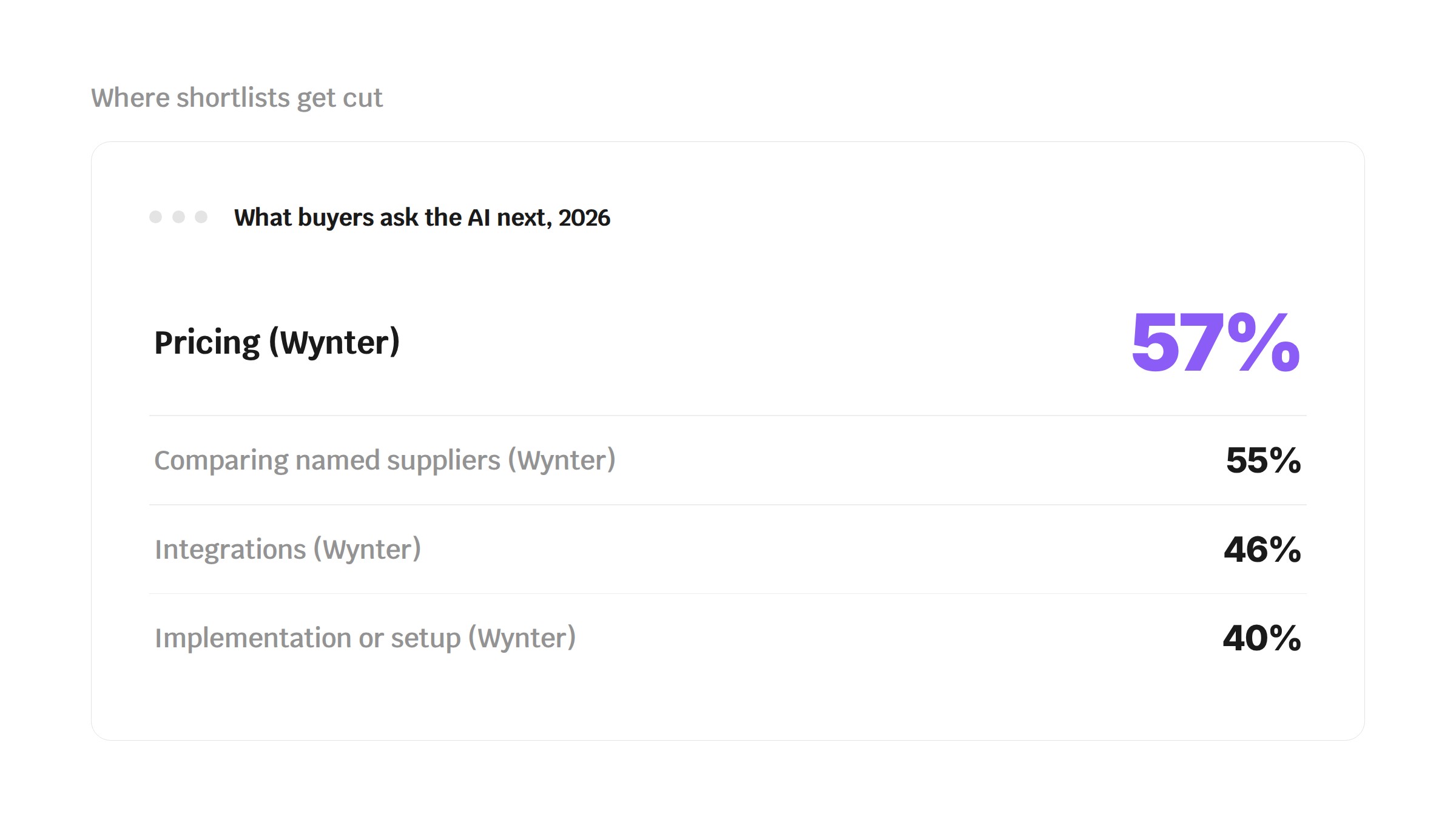
When buyers use AI to find suppliers, price is the thing they follow up on most. In Wynter's survey of 200 B2B buyers, 57% asked the AI about pricing in their follow-ups, more than any other topic. If you quote rather than publish a price list, that leaves the AI guessing just as the buyer starts cutting the list.
Does this matter for my kind of business?
We think food and drink production is the clearest case. Take a brand looking for a co-packer: its hard filters might be certification and grade, allergen handling, minimum run size, pack formats, chilled or ambient, where you are, and roughly what a run costs. A fabricator, a haulier or a packaging supplier is in the same position, with different filters.
It matters less if most of your work comes through a retailer's approved-supplier list, a public sector framework, or repeat customers who ring you direct. Those buyers may never touch an AI. This is about the new customer who doesn't know you yet, so check where your last ten new customers came from before you spend a day on it.
One more limit. Both studies below cover B2B buyers in general. Wynter's respondents were mostly in marketing, engineering and IT roles, researching software or service vendors, and Octane11's report doesn't break its clients down by sector. Neither is a study of industrial buyers. We think the mechanism carries over, but that's our judgement, not their finding. Price is where we'd expect the gap to be widest: a software firm with a pricing page gives the AI something to quote, and a food manufacturer that quotes job by job doesn't.
Why doesn't AI show up in my analytics?
Partly volume. AI engines accounted for 2.4% of B2B search sessions in Q3 2026, against roughly 96.6% for traditional search (Octane11, 650 million sessions).
The rest is timing and labelling. In Octane11's data, 72% of won deals with an AI touch had their first AI visit before the sales opportunity even existed in the CRM. The last AI visit came a median of 70 days before the deal closed, against 21 days for organic search. AI referrals also arrive without a company name attached, and once a deal is open, buyers come back through Google or Bing, often by searching your name (Octane11).
Small doesn't mean idle. Of the accounts that visited through an AI engine, 1.22% closed a won deal in Q3, against 0.49% for organic search, 2.5 times the rate (Octane11). Octane11 is clear these are correlations: AI visitors seem to be further along when they arrive, so the AI didn't necessarily persuade them.
How do buyers actually use AI to find a supplier?
Wynter asked 200 B2B buyers what they typed and what they did next (Wynter, November 2026):
- 62% of buyers opened with a plain category question naming no supplier, even though 80% already had one in mind.
- The median first prompt carried one buyer constraint, so the AI fills the gaps with assumptions.
- 75% sent three or more follow-ups. Pricing was the most common topic (57%), ahead of comparing named suppliers (55%), integrations (46%) and setup (40%).
- The first follow-up most often removed suppliers: 19% added a filter and 17% checked price.
- 67% of buyers said the AI added a supplier they hadn't considered, and it made their shortlist.
- 72% of buyers then went to supplier websites to check what the AI had told them.
Wynter's figures are buyers' own recall rather than chat logs, and it asks readers to treat its smaller breakdowns as directional. One buyer's follow-up shows how blunt the price cut can be: "We have a budget of $500/month. Please eliminate the vendors that don't fall within this limitation."
Here's an illustrative example in our sector. "Find me a contract manufacturer for chilled sauces in the north of England." Then: "Only BRCGS certified." Then: "Runs under 5,000 units." Then: "Which of these would do a first run for under £10,000?" If your site says "flexible, quality-led food manufacturing" and nothing about cost, the AI can't tell whether you pass any of those. So it guesses, or it drops you.
What should I say about price if I can't publish a price list?
You don't need a price list to answer the price question. An AI can work with any of these:
- Minimum order or minimum run. "Minimum run 2,000 units per SKU" answers a budget question on its own, because it tells a small brand they're too small before anyone wastes a call.
- Fixed charges. Setup, tooling, plates, trial batches, recipe development. If they're charged separately, say so and give the figure or a range.
- What drives the quote. Pack format, run length, whose ingredients, chilled or ambient, delivery. A buyer who knows what moves the price can tell the AI which version they need.
- A typical band for a typical job, labelled as typical. "Most first runs for a new brand land between £X and £Y" is useful if it's true for most of your work.
- How fast a quote comes back, and what you need to send. "We quote within three working days of a spec sheet" tells a buyer with a deadline whether to bother.
The figures in those examples are made up to show the shape; use your own. We do something similar ourselves: WK publishes no package prices, and the assistant on our site explains what drives the cost of the project a visitor describes.
When is publishing a figure a bad idea? When your prices move with ingredient, packaging or energy costs faster than you'd update the page. When the range is so wide it means nothing, or would scare off the jobs you want. When big contracted customers pay rates you can't show next to a public band. And when you won't keep it current, because Wynter's reading of its data is that the AI's description of a supplier, pricing included, gets copied into the documents the buying committee reads. A stale band can go further than a missing one. In any of those cases, publish the minimum, the fixed charges and the drivers, and leave the band off.
What if you leave price blank? Wynter's conclusion is that when something isn't clear in what's published about you, the AI guesses. A guess can place you in a band you aren't in, either way. Our judgement is that the bigger risk comes when a buyer says "drop anyone over budget": a supplier the AI can't place has no answer to that question, and is easy to drop. Wynter's own advice to vendors is to say how pricing works.
What else can I fix this week without paying anyone?
- Write down the filters. List the five questions that rule a supplier in or out in your trade, price included, then answer each in plain text on your site: certifications with grade and scope, minimum and maximum quantities, lead times, areas covered. Say what you don't do as well.
- Keep facts as text. Put your capabilities and pricing basis in sentences on the page, not only in a scanned PDF or an image.
- Run the conversation yourself. Ask ChatGPT, Gemini or Copilot the category question the way a new customer would, then add three follow-ups with real constraints, one of them about budget. Save the exact wording so you can run the same script again next month. Then act on where it goes wrong:
- You're not named in the first answer. The AI may not be connecting your words to the buyer's. Put the term a buyer would type ("contract manufacturer", "co-packer", "white label sauces") in the title and first heading of your main service page, not just "food solutions".
- You're named, then dropped after a follow-up. Note which follow-up. Chances are that filter isn't stated plainly anywhere the AI can read, so add it to the capabilities page as a sentence.
- It gets a fact wrong, such as your minimum run or certification grade. Ask it where it got that, then fix the source: an old brochure PDF, a directory listing or an outdated page. Wynter's advice is the same: fix the public sources behind any wrong answers.
- It guesses your price or says it has no pricing information. Add the price paragraph from the section above to the capabilities page, or to a short "how pricing works" page linked from it.
- Look at your referrals. In Google Analytics, check your referral sources for AI assistants such as ChatGPT, Perplexity, Gemini and Copilot. Expect small numbers, and remember that a buyer who first found you through an AI may come back later through Google.
Then look at the page those visitors land on. Wynter's point is that a buyer arriving with a shortlist and a budget cap needs to confirm in seconds who you're for and roughly what it costs.
When is it worth getting help?
When the filters run across several product lines, sites or certifications, or prices change every season, keeping them accurate by hand gets fiddly. That's when structure pays for itself: proper spec tables, a page per capability, and markup that tells machines what each fact is. It's part of our web design and development work.
Want to know what a buyer, or an AI, finds when they check your site? Get a free website health audit: it checks speed, search visibility and what AI crawlers can read on your page, and tells you what to fix first.
Got a projectin mind?Let's talk.
Tell us what you're building. We reply within a day.
A haulage client’s site: 4.8s to 2.5s on mobile, first enquiry on launch day.